Vesting is one of the most important design features in a cash balance plan, but it is often misunderstood. Many owners assume that once a contribution is made, it automatically belongs to the employee.
In reality, employer-funded benefits can be subject to a vesting schedule. That schedule determines when the employee has a nonforfeitable right to the plan benefit.
In this article, we’ll explain how vesting works in a cash balance plan and why the choice matters. We’ll compare cliff versus graded schedules in plain English and discuss how each impacts retention, plan cost, and forfeitures.
Background
It is common for a plan to provide that a participant will retain employer-funded retirement benefits only if the participant works for the employer for a certain period of time. This is called a “vesting” requirement.
Normal retirement age cannot be after the later of (a) age 65 or (b) the fifth anniversary of commencing participation in the plan. Plans may set an earlier normal retirement age, as early as age 62. Selecting a normal retirement age that is earlier than 62 is permitted only in limited circumstances.
If a participant terminates employment before completing the required service, all or part of the benefit is forfeited. Retirement benefits generally must vest (or become non-forfeitable) when the participant completes a requisite number of years of service or attains normal retirement age.
Graded vs Cliff
The best approach is to align vesting with your hiring patterns and retention goals, then document the decision clearly. Make sure employees understand the schedule and what triggers full vesting. Also confirm that your cash balance plan’s vesting provisions coordinate with your 401(k) plan, especially if both plans share eligibility rules.
Prior to attaining normal retirement age, participants will vest in their benefits based on service performed for the employer. The plan will set a vesting schedule, generally based on years of service.
In either case, the tax code establishes minimum vesting schedules, meaning the plan can vest benefits sooner. Plans are not permitted to provide slower vesting for participants than the minimum.
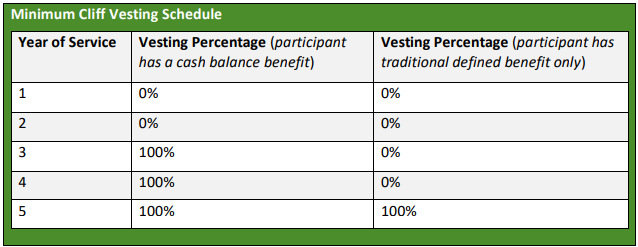
The schedule is either a “graded” vesting schedule (in which a portion [less than 100%] vests at certain service milestones) or a “cliff” vesting schedule (in which 100% of the benefit vests after a set amount of service). Both approaches are legal, but they create very different incentives and outcomes.
The following reflects the minimum vesting schedule for defined benefit plans:
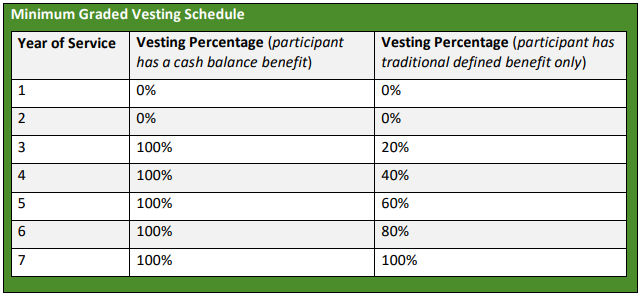
Cash balance plans may use a graded vesting schedule, BUT any participant who has a cash balance benefit must become 100% vested after 3 years of service.
From the employer’s perspective, vesting can also protect the plan when turnover is high. If someone leaves before they are vested, the non-vested portion typically becomes a forfeiture. Those forfeitures can often be used to reduce future employer contributions or offset plan expenses, depending on the plan document. That is why vesting design can have a real cash flow impact.
Top-Heavy Plans
Top-heavy plans, discussed previously, must have faster vesting minimums than other defined benefit plans, with 3-year cliff vesting or 6-year graded vesting required. Since cash balance plans must already have 3-year cliff vesting, a top-heavy cash balance plan does not need to change its vesting schedule.
Use EMPARION PLANS on



*Emparion is not affiliated with, endorsed by, or sponsored by these institutions.*
Termination
If a plan terminates, affected participants will become immediately vested in their benefits under the plan, even if they have not reached normal retirement age or the required service under the vesting schedule.
Protected Benefits
There are special rules that apply if an employer wishes to change a plan’s vesting schedule. However, because these rules may prevent the employer from changing vesting, it is critical for the employer to carefully consider the vesting schedule when initially designing the plan.
Bottom Line
Vesting rules in a cash balance plan are not just legal fine print. They shape how you reward long-term employees and manage the plan’s cost.
Cash balance plans commonly use either cliff vesting or graded vesting. Cliff vesting means the employee becomes 100% vested after a set period, with nothing guaranteed before then. Graded vesting increases ownership in steps each year until the employee reaches full vesting.
Cliff vesting can feel simple and “all or nothing,” which may fit smaller teams. Graded vesting spreads the benefit over time and can feel more predictable for employees. With the right structure, vesting becomes a tool that supports both compliance and business strategy.