At Emparion, approximately 75% of our retirement plans are sponsored by S-Corps and less than 5% are with partnerships. The calculations for each plan are a little different.
A structure that is increasingly common involves a partnership acting as an income “funnel,” distributing net profits to multiple S-corporations. Each S-Corp owner is a different person.
This article explores how defined benefit plans work within the “funnel-structure” of a partnership and multiple S-corporations. This article will be highlighting how contributions and account balances are tracked and outlines key technical considerations. Let’s dive in!
Some Background
Here’s how the structure works. Income comes into the partnership and related expenses are paid. The remaining net profit is divided up between the partners and flows directly into multiple S-corporations. Each partner or shareholder will issue a W-2 at the S-Corp level.
The structure is often used when the business owners have additional side income that come in at the S-Corp level that has nothing to do with the partnership operations. That way they have a mechanism to include the income from the partnership, while also including the unrelated side income.
S-Corps and partnerships are both “flow-through” entities. This means that the entities do not pay tax. The net income or loss merely flows through to the owners/partners. Remember that S-Corps can be partners in partnerships, but partnerships cannot be shareholders in S-Corps.
For an operating entity, if a partner to a partnership is an individual then, as a general rule, the net income will be subject to employment taxes. But if the partner is an S-Corp then the S-Corp acts like a “blocker” and is not subject to employment taxes.
However, each owner (or officer) must pay themselves a W2 based on reasonable compensation. So there is no way to completely eliminate employment taxes.
The issue with the structure is how do you structure the define benefit plan? Here is how it generally works:
- the partnership generates income and pays most business expenses;
- the profit flows to the S-Corps;
- the S-Corps issue W-2 wages to the owners;
- those wages are used to qualify for the defined benefit plan;
- each S-Corp funds a portion of the defined benefit plan; and
- the tax deduction for the S-Corp funding is taken at the S-Corp level.
But when you dig deeper, you discover the complexity of affiliated service groups, control-group rules, and how the defined benefit plan must include all related entities to ensure deductibility of contributions.
Affiliated Service Group Rules
Many business owners might ask the question: why can’t each dentist just have their own defined benefit plan at the S-Corp level?
Unfortunately, the Affiliated Service Group (ASG) rules make this challenging. These rules apply when two or more companies have common ownership and provide services to each other.
Under the ASG rules, the IRS treats all members of an affiliated service group as a single employer for retirement plan purposes. This means that if multiple entities are linked through ownership and shared services, they would be required to include all eligible employees under one plan.
The intent behind ASG rules is to prevent business owners from segmenting employees into separate entities to limit who can benefit from retirement plans. For example, a professional practice may have one corporation for owner-physicians and another for support staff. But even though the dentists have no other employees, there are still caught up in the ASG rules.
Use EMPARION PLANS on



*Emparion is not affiliated with, endorsed by, or sponsored by these institutions.*
Even though they are technically separate entities, if they provide services to the same clients or are structured to support each other’s operations, the IRS may determine that they form an affiliated service group. As a result, both entities would need to be treated as a single employer for plan eligibility, coverage testing, and contribution limits.
In my example, you have an ASG that includes the three entities. This is because there are affiliated services being provided from the partnership to the S Corps. Also, the three dentists own their s-Corps and indirectly are partners in the partnership through their S-Corps.
In addition, all four related entities must be included as affiliated businesses in the plan document to ensure deductibility of the contributions. This detail is often overlooked and could be a potential issue.
Dentist Example
Let’s look at an example. Assume there Is a dental partnership that generates $3 million a year in profit. The partners to the partnership are three S-corporations. The S-corporations are controlled by three separate shareholders.
Each shareholder owns 100% of their S-corporation. Let’s also assume that there are no other employees in any of the three entities.
Here is how this structure might look for 3 dentists:
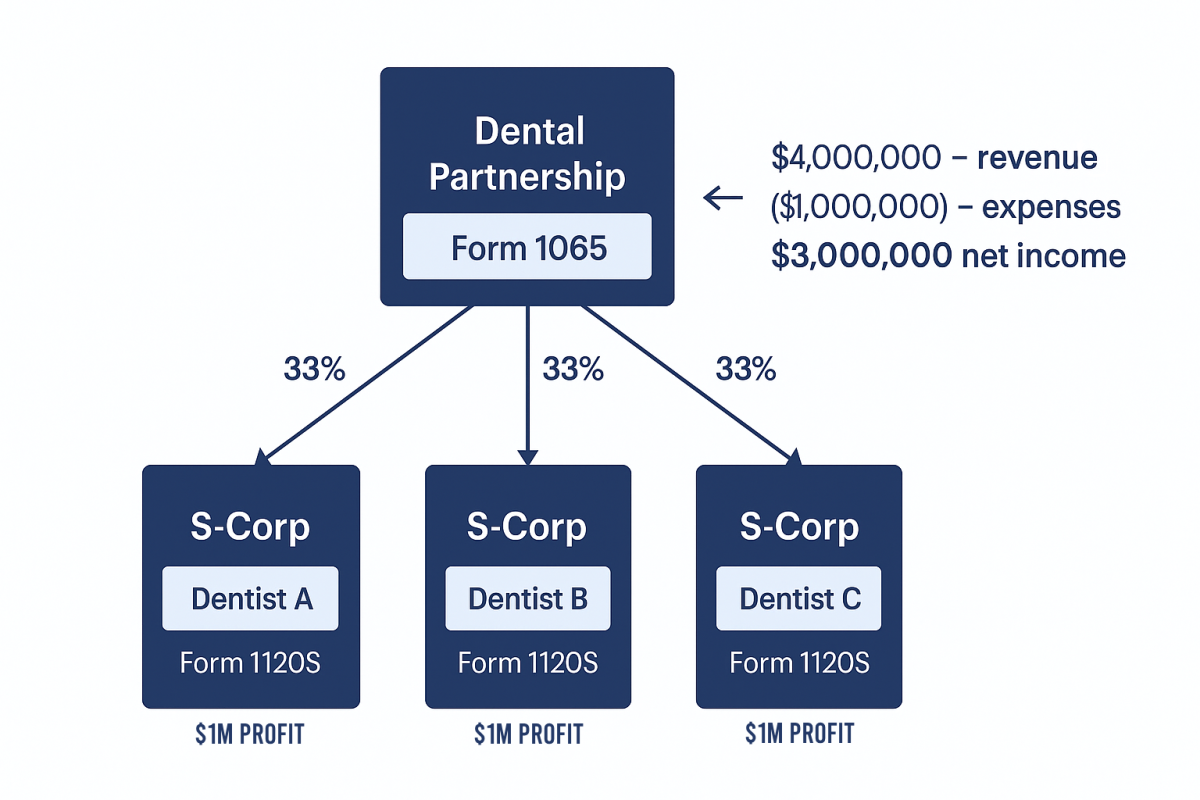
Once the $1 million worth of income flows to each S corporation, each owner will now have to have a W-2 at the S-Corp level. Let’s assume that the W-2 issued to each shareholder is $300,000.
Is a Cash Balance or Defined Benefit Plan Right For You?

Based on this W-2, the 40-year-old owner will be able to do a defined benefit plan contribution of $120,000 while the 45-year-old will be able to do a contribution of $150,000. Define benefit plans investment accounts are “pooled” accounts. So, any contributions (no matter who the partner or shareholder is) will be contributed to the same brokerage account and the administrator will track each shareholder contribution separately.
Each owner will write a check separately for their contributions and contribute them into the one account. Each owner will take the tax deduction for their separate contributions on their own individual corporate returns.
You would not record these contributions at the partnership level for two reasons: (1) there is no compensation at the partnership level; and (2) each shareholder has different contribution amounts and the partnership will distribute the tax items based on the ownership interest.
At the end of year one you now have a total contribution in the plan of $270,000 ($120,000 + $150,000). In year two, an interest crediting rate of 5% will be applied to each of these pay credit amounts.
If the assets grow at exactly 5% then, in theory, the account balance would always equal a contribution plus the pay credit. But in reality, you’re never going to earn exactly a 5% rate of return. So technically, at any point in time, the plan will always be underfunded or overfunded.
Let’s assume now that the two shareholders have been contributing a plan over a five-year period of time and have achieved asset growth in excess of 5%. Now they plan to terminate the plan and roll the assets over into an IRA. Let’s look at the accrued benefit for each shareholder, and then compare it to the account balance:
| Amount | |
|---|---|
| Accrued Benefit for 40-year-old | $500,000 |
| Accrued Benefit for 45-year-old | $400,000 |
| TOTAL | $900,000 |
| Investment Account Balance | $1,000,000 |
| Overfunding (Cushion) | $100,000 |
| Shareholder | Accrued Benefit | Investment Balance |
|---|---|---|
| 40-year-old | $500,000 | 555,555 |
| 45-year-old | $400,000 | 444,445 |
| TOTAL | $900,000 | 1,000,000 |
As you can see, this plan is overfunded. While it may not be overfunded for IRS termination purposes in applying an excise tax, there still is an unallocated amount that you must do something with.
The good news is that you have some flexibility into how to deal with that excess. When the plan is terminated, you have a process to equalize or allocate this amount back to the other partners.
In this situation, it would make sense to allocate the entire balance based on doing a weighted average based on the accrued benefit. So we would take a look at each shareholders accrued benefit to the total accrued benefit and apply that same percentage. The table below illustrates what it would look like:
Final Thoughts
Structuring a defined benefit plan for partnerships and S corporations can often be challenging. Success depends on careful coordination between the entities, proper allocation of W-2 wages, and compliance with the affiliated service group and controlled group rules.
Working with experienced advisors who understand entity structures and pension regulations can help ensure that the plan is implemented and maintained correctly. Accountants, actuaries, and third-party administrators must collaborate to determine the optimal contribution levels and test the plan across all related entities.
Ultimately, the right defined benefit plan structure can provide powerful long-term rewards. By taking the time to align ownership arrangements, compensation strategies, and plan design, business owners can create a compliant framework that delivers both immediate tax relief and lasting financial security.