Deciding whether or not to terminate a defined benefit plan can take time and effort. However, there are many times when it must be done for financial reasons.
One of the biggest concerns when you have a defined benefit plan is making sure that you make any final contributions (if required). In addition, you must determine that when you terminate the plan, it is not overfunded, thus triggering the excise tax penalty and reversion.
Your actuary can calculate whether or not you are overfunded. But there is a way for you to take a quick look yourself.
People often contact us with the following questions:
- How do I know if my plan is overfunded and an excise tax will be triggered?
- Will I be required to contribute any amounts to the plan before termination?
- When will the actuary tell me if my plan is technically overfunded?
These are all critical questions. Only an actuary can definitively answer them. Each client’s situation is unique.
But the goal of this post, is to give you a quick calculation to determine if your plan is overfunded. In addition, you’ll see the valuation amounts at the end of a fiscal year in the actual reports you’ll receive. This will give you a good idea of whether or not you are overfunded. We have an example of those reports below.
Of course, this analysis is just an estimate. There are many variables that must be considered. But at least you’ll know how much “cushion” (if any) you have if you’re considering terminating your plan. Let’s jump right in.
How to determine if your plan is overfunded
Here is a quick guide to getting an idea if your plan is overfunded:
- Determine your age in the final plan year.
- Determine how many years the plan has been open.
- Determine the 415 limit based on your age. You can find that here.
- Multiply the 415 limit by the number of years the plan has been open. This amount would be the maximum allowable amount, and I will call this the “cumulative 415 limit.”
- Finally, compare the current asset balance to the number calculated in #4. If the asset balance exceeds the cumulative 415 limit, you have an overfunding problem. But if the asset balance is below the accumulated 415 limit, you are not overfunded and can typically terminate the plan without excise tax penalties.
Termination funding example
Let’s take a look at an example. Assume the following plan characteristics:
- The client’s age is 57
- The plan has been open for five years
- The asset balance = $1,154,560
The first step is to reference the 415 limit. For example, you might find the 415 limit for a 57-year-old is $266,000.
Then when you multiply this amount by five years you get $1,330,000.
Finally, comparing this amount to the asset balance results in a cushion of $175,440. So, preliminarily, this plan is not overfunded.
But let’s change it up slightly. Assume now that the asset balance is $1,428,420. As a result, the plan would be overfunded by $98,420. In this situation, you likely can just keep the plan open for another year and then terminate it without any penalties or reversion.
What are the exceptions to the calculation?
Remember that this calculation is just a guide. It’ll just give you an idea of how close you are to the funding limit.
Use EMPARION PLANS on



*Emparion is not affiliated with, endorsed by, or sponsored by these institutions.*
What are the exceptions to the rule? This calculation usually overstates any funding cushion for people who are a bit younger and have historically low W-2s. Most clients terminate plans in their 50s and 60s, and their funding is acceptable in most situations.
But if you terminate your plan in your 40s or younger, and your W-2s have been on the low side (say $100,000), then you could find where this will overstate your cushion.
The 415 limit will generally provide you with the high end of the funding limit. That’s because, by definition, it is considered a limit. This can sometimes lead to cushion overstatement.
However, in most situations, defined benefit plans don’t make as much sense for people in their 30s and 40s, especially if their W-2s have been on the lower side.
Where is the 415 cap in the actuarial reports?
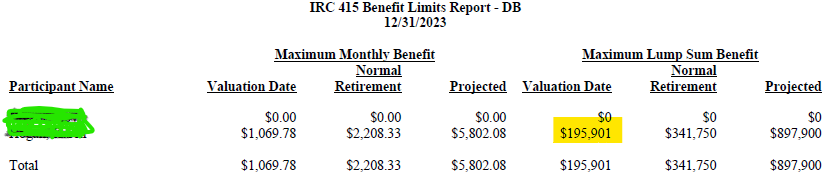
At the end of the year, your plan administrator will give you a Schedule SB and also an Actuarial Valuation Report. In that valuation report, there will be multiple schedules, including one that will be labeled something similar to “IRC 415 benefit limit.” This will typically note the amount of the 415 limit at the valuation and retirement dates.
The amount at the valuation date will give you the maximum payout a participant can receive at the date the valuation was performed. Take a look at a sample below:
Is a Cash Balance or Defined Benefit Plan Right For You?

If you don’t see the schedule above, it can be found in a schedule called Benefit Limits (415, 416 & 417(e)). Take a look below.

Final thoughts
Determining whether or not your defined benefit plan is overfunded upon termination is more challenging than you might think. Remember that defined benefit plans work substantially different from defined contribution plans. You need to make sure the final accrued benefit does not exceed the asset balance.
If you find the plan is overfunded, then often you just need to keep it open in extra year or so to correct. Assuming there is not substantial asset growth, this additional year will increase the accrued benefit and allow you to terminate a plan without paying any excise tax or IRS penalties.