A cash balance plan is a type of defined benefit plan with account style features. It credits pay credits and interest credits annually. Employers use these plans to generate large, deductible contributions for owners and key employees. In some cases, the plan can also purchase life insurance inside the trust.
Life insurance inside a cash balance plan can serve multiple objectives. It can provide survivor protection for owners and their families. It can also help protect promised benefits if a participant dies prematurely. However, the plan must follow strict IRS rules for incidental benefits.
The first requirement is meeting the incidental benefit rule for qualified plans. The second requirement is document based and often overlooked. The plan document must specifically permit insurance as an investment option. Without that language, insurance inside the plan can create serious compliance problems.
Understanding the Incidental Benefit Rule
The incidental benefit rule governs how much insurance a qualified plan can provide. The IRS wants retirement benefits to remain the primary purpose. Death benefits must be secondary or incidental to retirement income. This concept applies directly to cash balance plans that hold life insurance.
Under this framework, life insurance cannot dominate plan funding. Contributions must primarily support retirement benefits and actuarial liabilities. Insurance is allowed only up to specified limits tied to projected benefits. Staying within those limits keeps the coverage incidental, not primary.
Actuaries help monitor compliance with the incidental benefit rule. They measure projected benefits and compare them with total death benefit levels. They also review premium funding patterns and policy design over time. Regular actuarial reviews are crucial when insurance is held inside the plan.
Why the Plan Document Must Allow Insurance
Even if insurance satisfies the incidental benefit rule, the plan document still controls. The document sets the legal boundaries for plan operations and investments. If it does not permit life insurance, the plan should not purchase policies. Doing so could violate the written terms and invite regulatory scrutiny.
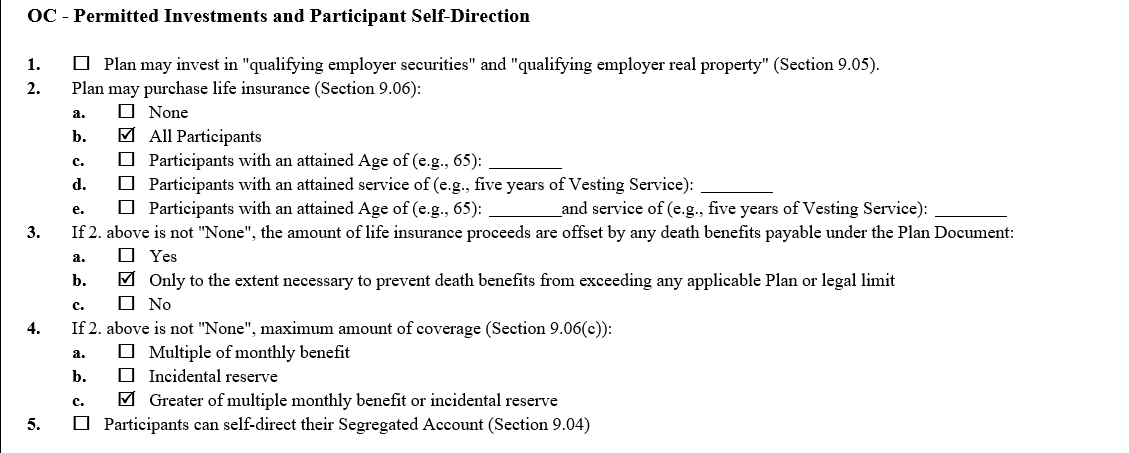
Many pre-approved cash balance documents include optional insurance provisions. These provisions might be turned on or off in the adoption agreement. Some documents allow only traditional investments like mutual funds and annuities. Others allow broader investment options, including life insurance contracts and annuities.
Trustees and sponsors must read the investment language very carefully. If life insurance is not clearly allowed, amendments may be required. The document should describe permissible investments in clear and flexible terms. It should also outline any specific conditions for holding insurance policies.
Document Changes and Investment Provisions
Adding insurance to a cash balance plan often requires document changes. The sponsor may need to amend the investment and trust sections. Amendments should authorize life insurance contracts as permissible trust investments. They should also reference regulatory requirements for incidental benefits and qualification.
Investment provisions might describe allowable asset types and vehicles. These can include mutual funds, pooled accounts, annuity contracts, and insurance policies. The language should support the trustee’s fiduciary responsibilities under ERISA. It should also allow sufficient flexibility for long term investment strategy.
Whenever a document is amended, timing and procedures matter greatly. Amendments must follow IRS and plan language requirements carefully. They must be executed and adopted properly, usually before significant changes occur. Sponsors should coordinate with their third party administrator and ERISA counsel.
Sample Insurance Allocation Scenarios
Insurance inside a cash balance plan can be structured in several ways. The allocation between traditional investments and life insurance premiums is strategic. Sponsors must consider funding objectives, risk tolerance, and benefit targets. The table below shows sample scenarios for illustration purposes.
Sample Insurance Allocation Scenarios:
| Scenario | Primary Plan Goal | Insurance Role | Document Considerations |
|---|---|---|---|
| Owner focused tax deferral | Maximize deductible contributions for owner | Provide modest death benefit for family | Plan must authorize limited insurance investments |
| Key employee retention strategy | Provide meaningful long term benefits | Offer supplemental coverage on key employees | Document should outline eligibility and allocation rules |
| Succession planning emphasis | Support buyout or succession arrangements | Help fund transition or buyout related benefits | Language should coordinate with related legal agreements |
| Conservative funding approach | Maintain stable contributions and funded status | Use smaller policies, majority in fixed income | Document should allow both insurance and bonds |
| Growth oriented allocation | Seek higher long term investment returns | Use limited insurance, larger equity allocation | Plan must permit diversified investment choices |
| Participant level customization | Tailor benefits for select individuals | Target policies for a few participants | Document should address optional participant insurance |
These examples are simplified and do not replace detailed actuarial work. Actual designs require customized projections and formal compliance testing. Every scenario must still respect the incidental benefit rule carefully. The plan document language must clearly support the chosen insurance structure.
Implementing Insurance in a Cash Balance Plan
Implementing insurance begins with a design conversation among the advisor team. The sponsor, actuary, and administrator should discuss objectives and constraints. They should evaluate contribution capacity and target retirement benefits. They must also assess whether insurance meaningfully supports those objectives.
The next step involves reviewing the existing plan language thoroughly. The team checks whether insurance is currently listed as a permissible investment. If not, they draft and adopt an appropriate amendment. That amendment must clearly authorize insurance as a permissible trust investment.
From there, the sponsor works closely with an insurance professional. They select carriers, policy types, and underwriting strategies carefully. Policies must align with incidental benefit requirements and funding levels. Ongoing monitoring is essential to maintain compliance and appropriate coverage.
Permitted Investments in Plan Documents
Below is sample language that is selected to allow insurance:
Practical Checklist for Sponsors Considering Insurance
A structured checklist can help sponsors avoid mistakes with insurance. It organizes the key design and compliance questions in one place. It also ensures proper coordination among all service providers. The following points highlight core items to review carefully.
- Confirm overall goals for adding insurance to the cash balance plan.
- Review the plan document and adoption agreement investment provisions.
- Determine whether an amendment is required to permit life insurance.
- Validate that projected death benefits satisfy the incidental benefit rule.
- Coordinate with the actuary regarding funding, liabilities, and testing.
- Engage an experienced insurance professional familiar with qualified plans.
- Establish a schedule for ongoing review of policies and compliance.
Sponsors should document each step of this process carefully. Meeting minutes and resolutions can support fiduciary decisions later. Written records also help demonstrate prudent monitoring and due diligence. That documentation becomes important during audits or regulatory reviews.
Key Takeaways
Including life insurance inside a cash balance plan can offer meaningful advantages. It may enhance family protection and business continuity planning. It can also align with retirement benefit goals when structured thoughtfully. However, regulatory compliance must always come first.
Is a Cash Balance or Defined Benefit Plan Right For You?

The incidental benefit rule is the central regulatory safeguard for insurance. It ensures retirement income remains the plan’s primary purpose. Death benefits must stay secondary and appropriately limited in scale. Actuarial oversight is critical when insurance is part of the funding design.
Equally important, the plan document must clearly allow insurance. Investment provisions should support the desired strategy and operational flexibility. Sponsors should coordinate document language, actuarial work, and insurance design. With a coherent approach, a cash balance plan with insurance can remain compliant and effective.