Cash balance plans have become a valuable tool for retirement planning. One of their most important features is the ability to incorporate life insurance into the plan.
The best way to analyze this approach is to look at some client illustrations and examples. That way, you can see the different components and better understand how this type of structure can work for you.
Let’s explore how life insurance works within cash balance plans and its benefits for participants and employers.
Some Background
Life insurance in a cash balance plan is beneficial for two main reasons. First, the policy acts as an asset of the plan. This means that the cash value of the policy is included in the participant’s hypothetical account and is utilized to deliver the promised benefit at retirement.
Second, the policy’s death benefit ensures the plan can be completed. If a participant were to pass away before reaching normal retirement age, their accrued benefit may not be sufficient to support their family.
Life insurance in a cash balance plan provides financial protection for the participant’s family in the event of the participant’s premature death by offering an additional benefit. For life insurance to be effective within a cash balance plan, it should be a cash value insurance product. Typically, cash balance plans utilize either a whole life policy or a universal life insurance policy that comes with a guaranteed interest rate.
Illustration #1 – Target Funding Example
This first example is a 55-year-old who has a W-2 of $280k and is looking to get $250k into a cash balance plan. Take a look at the illustration below:

Cash balance plans follow the 50% rule when it comes to, including insurance in the plan. However, in practice, we prefer to be a little bit more conservative on the insurance side and put 40% of the total contribution into insurance. With a total contribution of $250k, $100k (or 40%) will go into life insurance with the remainder going into other investments like stocks, bonds, and mutual funds.
The illustration represents a “base” or “target” contribution. That means that with an age of 55, the client will get in the largest contribution possible without pulling in any “prior” service. We will discuss prior service in the next example.
This example is very straightforward. The client is not combining the plan with a 401(k) plan and is not frontloading the plan. For every dollar in compensation, the client can get about $.90 into the defined benefit plan.
Illustration #2 – Frontloaded Combo Plan Example
This second illustration is based on the same 55 year-old business owner. The compensation is also the same at $280k. But in this example, we are frontloading the plan. This means that we’re pulling in prior services performed for the company in order to get the year one contribution higher.
As such, we were able to get a year one cash balance plan contribution of $310k based on a salary of $280k. So, for each dollar of compensation, we were able to get $1.10 into the cash balance plan. Take a look at the illustration below:
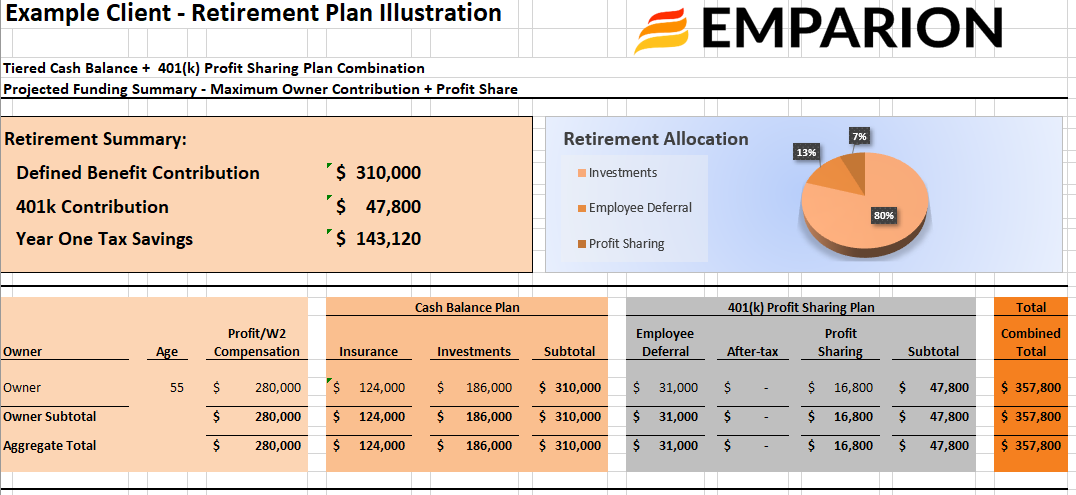
Remember though that prior service is only applicable in year one. With the frontloaded plan design, it will tend to decrease contributions in the following years. Similar to the first illustration, we include 40% of the cash balance plan contribution into life insurance.
Another change from the first illustration is that the client is also utilizing a 401(k) plan. With a solo plan, the client may contribute the full deferral amount of $31,000 without restriction. This is because these are employee contributions and not employer.
However, when a 401(k) is combine with a cash balance plan, you are limited to a profit sharing of 6% of the W-2 compensation. So, even though you lose some funding on the profit-sharing, you’ll pick up a large contribution on the cash balance plan side. The end result is a substantial year one total contribution of just over $357k.
Illustration #3 – Owner + Spouse Combo Design
This third plan is a little different. We actually have two participants: the business owner and the spouse.
The business owner is 52 and the spouse is 48. Compensation is slightly lower than the prior examples. It is not uncommon to defined a business owner who works full-time in the business and has a spouse that works part-time doing bookkeeping and other administrative tasks. As a result, there is a large discrepancy in their compensation. Take a look below:
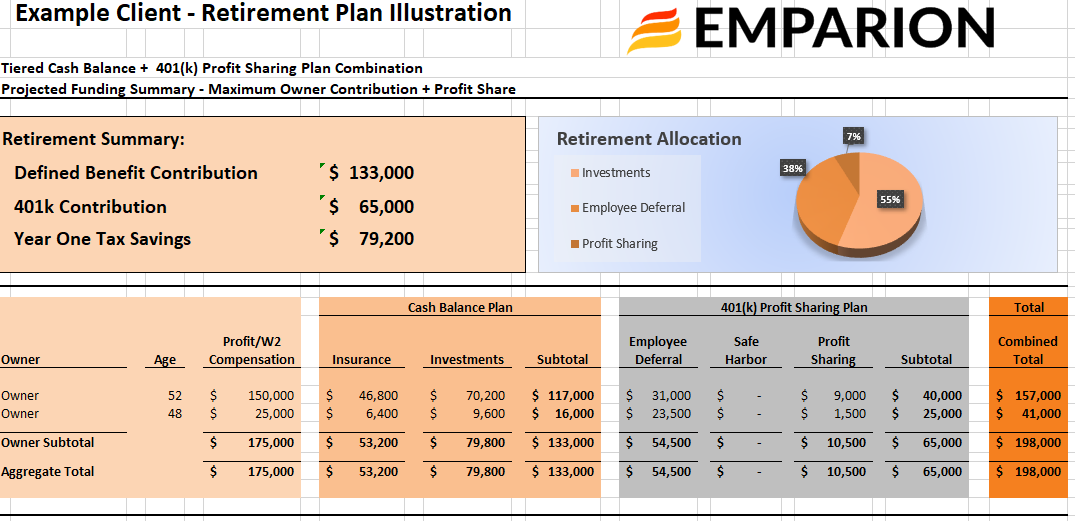
As a general rule, you want to have the spouse earning a W-2 that is high enough to at least allow a full deferral based on their age. But remember compensation has to always be reasonable under the IRS rules.
This illustration also is a target plan and will not include any front loading. Again, the insurance is based on 40% of the total overall cash balance plan contribution. In addition, both owner and spouse are maximizing the 401(k) plan, subject to the 6% limitation.
| Aspect | Explanation | Benefit | Limitation |
|---|---|---|---|
| Plan Asset Use | Policies such as whole life or UL are owned by the plan and funded with plan contributions. | Combines retirement benefit funding with death benefit protection. | Premiums reduce other investment allocations inside the plan. |
| Death Benefit Role | Provides survivor benefits if the participant dies before retirement. | Ensures family security and plan liquidity for obligations. | Only net at risk portion is income-tax-free. |
| Cash Value Treatment | Cash value is treated as part of the retirement account. | Grows tax-deferred and helps fund the promised benefit. | May be taxable to beneficiaries when distributed. |
| Tax Implications | Net at risk death benefit is tax-free; cash value portion taxable when paid out. | Preserves retirement plan tax advantages. | Complex reporting and compliance requirements. |
| Best Fit | Often used by high earners or small business owners with strong cash flow. | Enhances estate planning and legacy goals. | Must remain incidental to retirement purpose under IRS rules. |
Bottom Line
Incorporating life insurance into a cash balance plan isn’t just about protection—it’s a powerful strategy to enhance retirement savings, unlock tax advantages, and achieve long-term financial goals. Whether you’re looking to boost contributions, protect your loved ones, or reduce your taxable income, the right structure can provide meaningful results.
As with any advanced planning technique, execution matters. Each scenario requires careful coordination between plan design, insurance selection, and IRS compliance. The examples above highlight just a few of the creative ways this strategy can be leveraged.
If you’re a business owner or high-income professional seeking a custom-tailored solution, Emparion can help you navigate the complexities and build a plan that maximizes both protection and performance.
Is a Cash Balance or Defined Benefit Plan Right For You?