As a plan administrator, we often discuss overfunding and underfunding with our clients. It usually comes up when clients are trying to get an idea of how much they can fund their defined benefit plan in a given year. In many situations, we start with examining the funding status at the end of the prior year.
Actuaries can give you many technical answers on overfunding and even provide projections. However, the goal of this post is to give you a “quick” approach to looking through your year-end reports and IRS filings to determine if your plan is overfunded.
There may have been substantial activity that has occurred subsequent to year-end that has changed the overall plan funding status. But at least this will give you a snapshot in time. Let’s jump in!
Asset vs Liability
One of the easiest ways to know that your plan is overfunded is to look at the funding range you’ve received. You are likely overfunded if your minimum is zero and your target is zero (or close to it). But we’re going to take a quick look at some of your year-end reports to show you how to determine this amount.
But first, there are two important concepts to understand when it comes to defined benefit plans:
- Plan assets. These are the investments that are held in the plan that will be used in the future to pay participants. In most situations, this is the investment account balance.
- Plan liability. This is the balance owed to the employees as of that date.
Taking a closer look, the actuary wants to know that the assets are sufficient to cover this liability. The IRS requires the actuary to certify that this asset is sufficient enough to meet this liability as of the plan year-end.
The actuaries are merely balancing the assets and the liabilities to make sure the funding is reasonable, and there will be sufficient assets to pay out the employees at some date in the future. This is why your contributions and asset returns are so critical.
Why is it Important to Know if Your Defined Benefit Plan is Overfunded
Overfunded defined pension plans can lead to several financial and tax-related complications. Although this surplus might appear as a financial cushion, the IRS imposes strict limits on how much can be contributed to and accumulated within these plans. Exceeding these limits upon termination can result in hefty IRS excise taxes and penalties.
For these reasons, maintaining an optimal funding balance is crucial, as it ensures compliance with regulations, keeps the plan aligned with financial goals, and reduces the risk of penalties and financial inflexibility.
In a perfect world, the investments would equal the accrued benefit. But this rarely happens. Because we don’t have full control over asset returns, it’s very common for plans to be slightly underfunded or slightly overfunded. But we don’t want to get them too far apart from the accrued benefit.
Examining the Benefit Limits
As part of your year-end reporting, you will receive many reports. There is one lengthy report that is commonly referred to as the “Actual Valuation” (or “Act Val”). In this report, there will be many different schedules that will explain benefits, accrued amounts, and other information.
Look through the report and locate the schedule that details the benefit limits. Specifically, try to find the schedule that looks similar to the following:
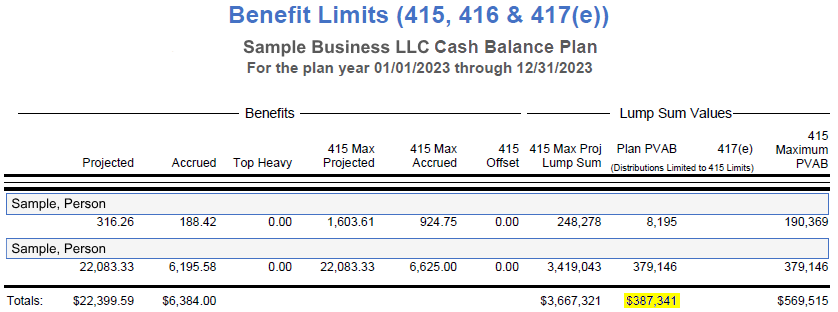
Take a look at the highlighted number of $387,341. This number is in the column labeled “Plan PVAB”. The PVAB stands for the Present Value of Accrued Benefit.
Specifically, this number represents the present value of the accrued benefit for all employees as of the end of the plan year. This is the amount you would want to have in your investment account to cover these benefits.
Use EMPARION PLANS on



*Emparion is not affiliated with, endorsed by, or sponsored by these institutions.*
But remember the IRS allows you to overfund (and in some cases underfund) this accrued benefit amount. So, then we want to move on to the next step to find the asset balance as of the end of the year.
When you run this analysis, it is being done as of the date of the plan year-end (typically 12/31). There may have been substantial activity that has occurred subsequent to year-end that has changed the overall plan funding substantially.
Form 5500
The next thing you’ll want to do is pull up your IRS Form 5500. This form is required when the plan asset balance is greater than $250,000. This form is also required to be filed when the combined balance between a defined benefit plan and a 401(k) plan is $250,000. In this case, you would file 5500 for each plan.
Form 5500s are usually easier to understand than actuarial valuations. They mostly roll forward the plan assets and participant contributions that occurred during the year.
There are three types of 5500s that are filed: 5500-EZ, 5500-SF, and a full 5500. Pull up the form and look for the line that has the ending asset amount. Take a look at the sample one below:

Taking a look at Part III of the Form 5500 above, you can see that the plan assets at the end of the year were $521,001. This amount represents plan assets that are held in trust to pay out future benefit benefits to employees. Now on to the final step.
Completing the Calculation
The final step is the easy part. You will just compare the asset balance on the Form 5500 to the liability balance on the benefit limit report.
Is a Cash Balance or Defined Benefit Plan Right For You?

To the extent the assets exceed the plan liability, your plan is overfunded. However, if the liability exceeds the asset, then your plan is underfunded.
In this example, you can see the calculation below:
| Amount | |
|---|---|
| Investments (Asset) | $521,001 |
| Less: Accrued Benefit (Liability) | $387,341 |
| Overfunded | $133,660 |
As you can see, the plan is technically overfunded by $133,660. This is not necessarily a problem. It could possibly be an issued if the company was looking to immediately terminate the plan. But this amount will likely be used to cover additional accrued benefits that are earned in future years.
Final Thoughts
Overfunding a defined benefit plan is possible but can have potential consequences. This situation arises when an employer contributes more money than is necessary to meet the plan’s benefit obligations. Factors that can lead to overfunding include higher-than-expected investment returns or lower-than-anticipated liabilities resulting from changes in demographics or benefit design.
Companies can take steps to manage the risk of overfunding a defined benefit plan. This can include adjusting the plan’s investment strategy or increasing participant benefits. Working with a TPA and financial advisor is crucial to ensure that contributions are made wisely and tax-efficiently while complying with relevant laws and regulations.